Heavy-Duty Pancake Type Load Cell for Hydraulic Testing & Machinery: The Complete Guide
Precise force measurement in hydraulic machinery is rarely straightforward. High dynamic shocks, continuous cyclic stress, and off-axis side loads can quickly degrade standard sensors. For hydraulic presses, proof-testing rigs, and heavy industrial automation, the heavy-duty pancake type load cell (often referred to as a low-profile, shear-web, or spoke-type load cell) has emerged as the industry standard.
This guide explores how pancake load cells operate, why their mechanical architecture excels in harsh hydraulic environments, and how to select the right unit for your machinery.
What Is a Pancake Type Load Cell?
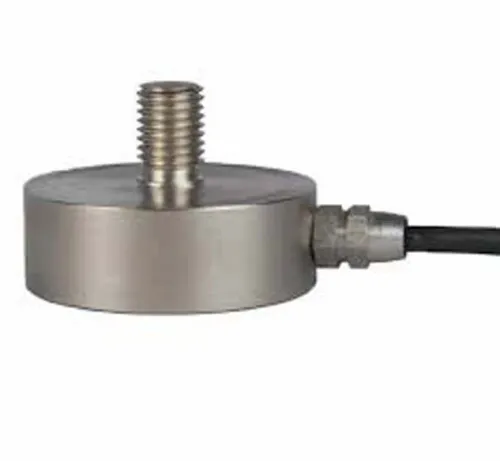
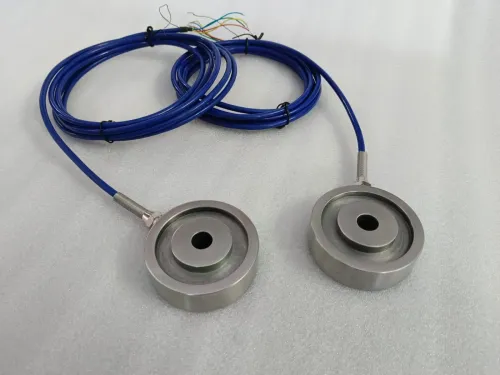
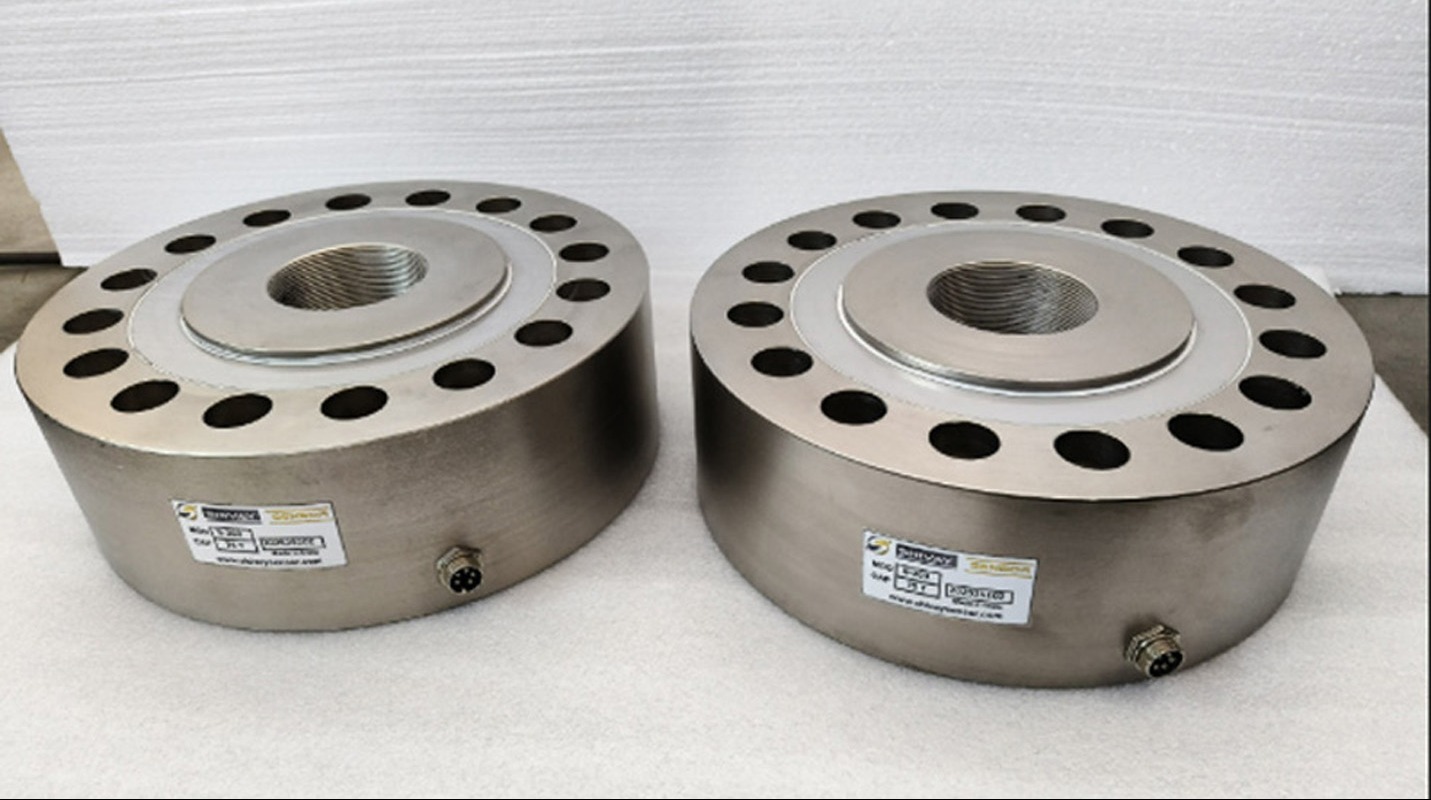
A pancake load cell is a low-profile, circular force sensor engineered around a central threaded hub connected to an outer ring by radial shear webs or diaphragms.
When an axial load—either compression or tension—is applied to the central hub, the radial spokes undergo shear stress. High-precision foil strain gauges bonded to these internal webs detect micro-strains, converting mechanical deflection into an electrical signal via a Wheatstone bridge circuit.
Key Technical Specifications at a Glance
SpecificationTypical Industry BenchmarkCapacity Range1,000 lbs to 500,000+ lbs (5 kN to 2,500+ kN)Form FactorLow profile (height typically 25% to 40% of outer diameter)Combined Error$pm 0.05%$ to $pm 0.1%$ of Full Scale (FS)Repeatability$le pm 0.02%$ FSMaterial Construction17-4 PH stainless steel or high-strength alloy steelFatigue Rating$10^7$ to $10^8$ fully reversed loading cycles (model-dependent)Ingress ProtectionIP67 to IP68 (welded hermetic seal available)
Why Hydraulic Machinery Demands Pancake Load Cells
Hydraulic actuators generate immense force within constrained spaces, often subjecting measurement equipment to hostile conditions. Pancake cells solve the three most common failure points found in alternative sensor geometries:
1. Superior Resistance to Extraneous and Off-Axis Loads
Canister and single-column load cells are notoriously vulnerable to side loading, bending moments, and eccentric forces. In hydraulic presses, platen misalignment or uneven tooling surfaces frequently impart non-axial vectors.
The radial shear-web architecture of a pancake load cell inherently cancels out extraneous side forces. The symmetric spokes flex symmetrically under axial force, whereas lateral loads produce opposing signals on opposite gauges that cancel out in the balanced bridge.
2. High Fatigue Life Under Rapid Cycling
Hydraulic testing machines (e.g., fatigue rigs, component testing benches, cyclic proof presses) operate over millions of continuous load reversals. Pancake load cells designed with fatigue-rated geometry operate well below the material’s endurance limit, preventing micro-fractures and zero-balance drift over tens of millions of cycles.
3. Compact Vertical Footprint
Hydraulic machine retrofits and existing press daylight spaces leave little vertical room. A pancake load cell provides high structural stiffness and multi-ton capacity in an envelope often measuring just 1 to 4 inches (25 to 100 mm) in height, minimizing stroke loss.
Primary Applications in Heavy Industry
- Hydraulic Presses (Forging, Stamping, Powder Compacting): Real-time closed-loop feedback ensures consistent clamping tonnage, prevents tooling damage, and flags hydraulic pump degradation before part tolerance fails.
- Component Proof-Testing Rigs: Structural proof testing for aerospace actuators, crane cables, and automotive fasteners requires continuous logging across bidirectional (tension-through-zero to compression) profiles.
- Hydraulic Jack and Ram Calibration: Pancake cells serve as secondary master standards during the on-site calibration of heavy hydraulic cylinders and jacks.
Pancake vs. Alternative Load Cells in Hydraulic Systems
FeaturePancake (Shear Web)Canister / ColumnS-BeamSide Load ResistanceExcellentPoorModerateProfile / HeightVery LowTallMediumFatigue LifeHigh ($10^7$–$10^8$ cycles)ModerateLow to ModerateBi-Directional TestingYes (Threaded Hub)Typically Compression OnlyYes (Threaded Eyes)CostMid to HighModerateLow to Mid
While S-beams work well for lower capacities ($< 5text{ tons}$) and canisters handle massive, unidirectional vertical loads where side load is eliminated, pancake cells provide the best balance of safety, multi-axis stiffness, and longevity for heavy, dynamic hydraulic circuits.
Installation and Engineering Best Practices
To extract the cataloged accuracy ($pm 0.05%$) from a pancake sensor, installation geometry must be strictly controlled:
- Surface Flatness and Rigidity: Mount the outer ring to a rigid base machined flat to within $0.0005text{ inches per inch}$ ($0.013text{ mm}$ per $25text{ mm}$). Flexure of the base plate introduces artificial strain into the outer ring, directly causing non-linearity.
- Use of a Base Plate: In compression-only setups, always use the manufacturer-recommended bottom sub-base plate. This plate closes the internal cavity, protects the lower diaphragm, and standardizes the boundary constraints.
- Thread Engagement: Ensure the threaded actuator stud or rod end engages the center hub to the full specified depth. Inadequate thread contact risks stripping under peak pressure surges.
- Torque Specifications: Torque all outer perimeter bolts in a star pattern to the specified value. Uneven clamping forces distort the sensor housing.
How to Select the Right Pancake Load Cell
When specifying a unit for your hydraulic machinery, evaluate the following variables:
- Static vs. Fatigue Rating: If your application undergoes continuous cycling (such as 1 Hz to 10 Hz fatigue rigs), specify a fatigue-rated cell sized to at least $150%$ to $200%$ of working tonnage.
- Loading Direction: Determine if the application requires compression only or through-zero tension/compression. Universal pancake cells feature internal central threading on both sides.
- Overload Margin: Hydraulic valves can produce rapid pressure spikes (water hammer). Look for safe overload ratings of at least $150%text{ FS}$ and an ultimate overload rating of $300%text{ FS}$.
- Environmental Sealing: Standard industrial presses require IP65 or IP67 protection against hydraulic fluid vapor, oil splatter, and washdown. Hermetically sealed welded constructions are mandatory in corrosive or outdoor testing environments.
#LoadCell #PancakeLoadCell #HydraulicPress #IndustrialAutomation #ForceMeasurement #MechanicalEngineering #SensorTechnology #TestingAndMeasurement #LoadCells #HydraulicMachinery #ForceSensors #IndustrialTesting #MechanicalEngineering #FactoryAutomation #ConditionMonitoring #ProcessControl #HydraulicSystem #ProofTesting #FatigueTesting #Instrumentation #SensorsAndSensors #IndustrialEquipment #ShearWebLoadCell #HeavyMachinery
Keywords