Business logo
Home
About
About UsFAQ
Products
COMPRESSION LOAD CELLSINGLE POINT LOAD CELLForce TransducerS BEAMTORQUE SENSORView All
Latest News
Gallery
Photos
Brochure
Multi-Column Load CellTank Weighing SS Load CellCompression Load CellVibrating Wire Load CellThreaded Button Load CellFemale Threaded Button Load CellView All
More
Tablet Compression Force Measurement | Pill Press Force VerificationInjection Molding Force FeedbackSpring Force Tension Sensor | Spring Testing SystemDrop Test Load CellsView All
Contact
08048051988
Home
About UsFAQ
COMPRESSION LOAD CELLSINGLE POINT LOAD CELLForce TransducerS BEAMTORQUE SENSORView All
Latest News
Photos
Multi-Column Load CellTank Weighing SS Load CellCompression Load CellVibrating Wire Load CellThreaded Button Load CellFemale Threaded Button Load CellView All
Tablet Compression Force Measurement | Pill Press Force VerificationInjection Molding Force FeedbackSpring Force Tension Sensor | Spring Testing SystemDrop Test Load CellsView All
Contact
08048051988
  1. Home>
  2. Latest News

Latest updates

Heavy-Duty Pancake Type Load Cell for Hydraulic Testing & Machinery

Heavy-Duty Pancake Type Load Cell for Hydraulic Testing & Machinery: The Complete Guide

Precise force measurement in hydraulic machinery is rarely straightforward. High dynamic shocks, continuous cyclic stress, and off-axis side loads can quickly degrade standard sensors. For hydraulic presses, proof-testing rigs, and heavy industrial automation, the heavy-duty pancake type load cell (often referred to as a low-profile, shear-web, or spoke-type load cell) has emerged as the industry standard.

This guide explores how pancake load cells operate, why their mechanical architecture excels in harsh hydraulic environments, and how to select the right unit for your machinery.

What Is a Pancake Type Load Cell?

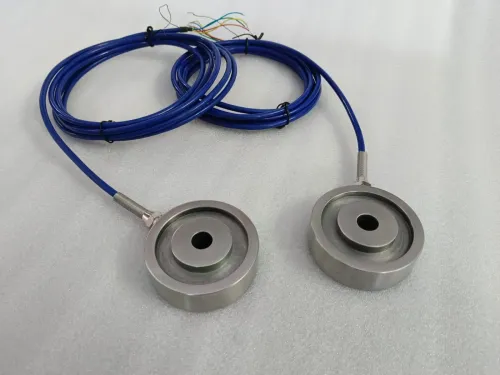
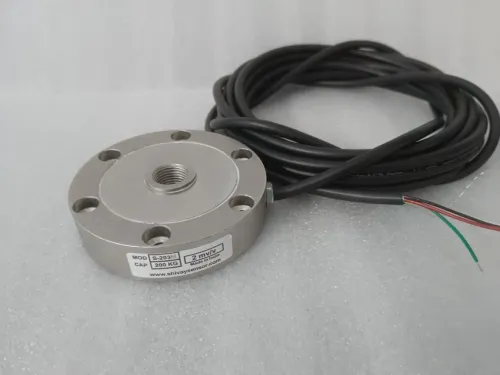
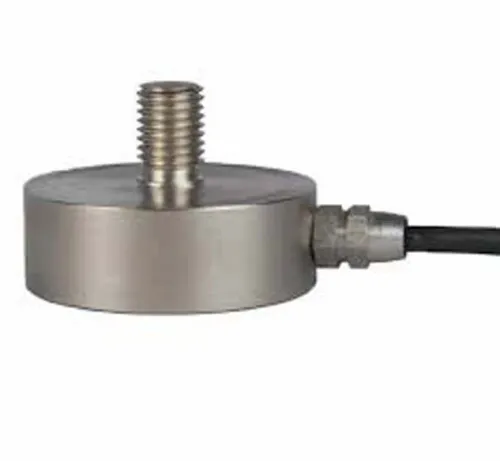
A pancake load cell is a low-profile, circular force sensor engineered around a central threaded hub connected to an outer ring by radial shear webs or diaphragms.

When an axial load—either compression or tension—is applied to the central hub, the radial spokes undergo shear stress. High-precision foil strain gauges bonded to these internal webs detect micro-strains, converting mechanical deflection into an electrical signal via a Wheatstone bridge circuit.
Key Technical Specifications…

Read updateOct 26th, 2026 3:32 PM

Miniature Threaded Button Load Cell – High Precision

Miniature Threaded Button Load Cells: The Engineer’s Guide to High-Precision Force Measurement

In modern industrial automation, robotics, and aerospace testing, machine footprints are shrinking while performance tolerances grow tighter. When test benches, OEM assemblies, or quality assurance rigs require micro-force monitoring in tight quarters, standard S-beam or canister load cells simply cannot fit.

This is where the miniature threaded button load cell excels. Engineered specifically to combine subminiature form factors with mechanical stability, these sensors deliver laboratory-grade compression data without sacrificing structural rigidity.

What Is a Miniature Threaded Button Load Cell?

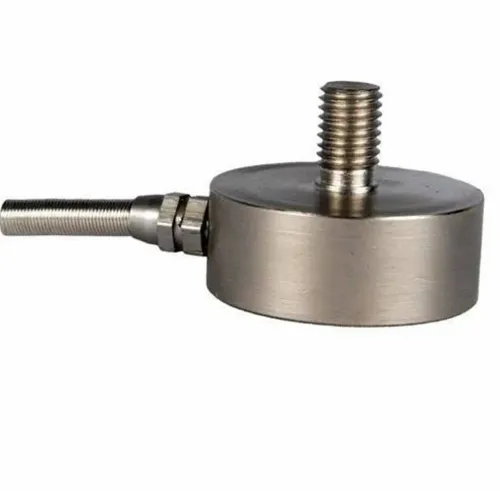
A threaded button load cell (often called a threaded load button or subminiature compression sensor) is a compact strain-gauge sensor designed for compression force measurement.

Unlike standard flat load buttons that rely entirely on surface friction or external clamping fixtures, the threaded variant features an integrated male or female threaded stud (typically M3, M4, M5, or standard imperial threads like #4-40 or 1/4-28).

Key Technical Specs at a Glance:

  • Operating Principle: Metal foil strain…
Read updateOct 24th, 2026 2:57 PM

Customized Load Cells | OEM & Industrial Force Sensors

Customized Load Cells: The Complete Engineering Guide for OEM & Industrial Force Sensors

Standard off-the-shelf load cells work well for conventional weighing scales and standard testing rigs. However, modern machinery designs, harsh operating environments, and tight mechanical envelopes often demand tailored solutions. When physical dimensions, mounting constraints, or environmental factors rule out standard components, customized load cells and OEM force sensors ensure accurate, reliable measurement without compromising equipment geometry.

Here is an in-depth breakdown of when to customize, the mechanical and electrical engineering process, and how OEM force sensors are developed for mission-critical industrial applications.

When Does an Application Require a Custom Load Cell?

Opting for a bespoke force sensor is typically driven by specific mechanical, environmental, or signal-processing limitations:

  • Envelope & Geometry Constraints: Compact medical devices, robotics, or space-constrained automated machinery often lack the clearance needed for standard S-beam or canister cells.

  • Direct Structural Integration: Applications such as heavy-lift cranes, mooring lines, or clevis…
Read updateOct 19th, 2026 3:33 PM

Low Profile Donut Load Cells | Bolt Tension & Force Measurement

Low Profile Donut Load Cells: The Complete Guide to Bolt Tension & Force Measurement

Meta Title: Low Profile Donut Load Cells | Bolt Tension & Force Measurement

Meta Description: Discover how low profile donut load cells (through-hole load cells) measure bolt tension, clamping force, and axial loads in tight industrial spaces.

Target Keywords: low profile donut load cell, through-hole load cell, bolt tension measurement, bolt preload monitoring, force measurement sensor

Securing critical mechanical assemblies requires precise clamping force. Relying strictly on torque wrenches introduces significant error—often up to 30% variation in actual clamp force due to thread friction, lubrication variance, and surface roughness.

To achieve true, repeatable accuracy in tight clearances, design engineers and test technicians turn to low profile donut load cells (also called through-hole load cells).

Here is a practical breakdown of how low-profile donut load cells work, why direct bolt tension monitoring outperforms torque estimation, and how to select the right sensor for compact installations.

What Is a Low Profile Donut Load Cell?

A donut load cell is a force transducer characterized by a…

Read updateOct 17th, 2026 3:00 PM

Aerospace & Space Industry Load Cells | Custom Force Sensors

Aerospace & Space Industry Load Cells: Engineering Custom Force Sensors for Extreme Environments

In space exploration and modern aerospace engineering, structural tolerances leave zero margin for error. Measuring structural tension on an airframe, quantifying stage-separation dynamics, or testing rocket engine thrust requires force measurement systems that perform predictably under conditions that destroy standard industrial sensors.

Aerospace and space industry load cells must withstand extreme mechanical shock, severe cryogenic and thermal extremes, ultra-high vacuum environments, and intense radiation fields—all while delivering sub-millinewton to multi-meganewton precision. Standard off-the-shelf sensors rarely meet these flight or ground-test specifications, making custom force sensors an engineering necessity.

Why Standard Load Cells Fail in Space Applications

Industrial-grade load cells are designed for stable, ambient factory settings. When exposed to launch profiles or outer space environments, they fail rapidly due to three primary environmental drivers:

1. Thermal Cycling and Cryogenic Shock

Propulsion test stands frequently cycle from liquid nitrogen or liquid oxygen…

Read updateOct 15th, 2026 3:09 PM

Precision Load Cell Signal Conditioners & Converters

Precision Load Cell Signal Conditioners & Converters: The Complete Engineering Guide

In precision weighing, automated test stands, and industrial process control, the accuracy of your measurement system depends entirely on how clean your sensor signal remains between the transducer and the controller.

A strain gauge load cell produces an exceptionally small electrical output—typically in the millivolt range. Without specialized processing, this raw signal is vulnerable to electromagnetic interference (EMI), line resistance losses, and ambient thermal drift.

A precision load cell signal conditioner and converter bridges the gap between mechanical force and readable data. It converts delicate millivolt signals into robust, standardized analog outputs or high-resolution digital streams suitable for PLCs, PACs, and SCADA systems.

What Does a Load Cell Signal Conditioner Actually Do?

At its core, a load cell signal conditioner performs five essential signal chain operations:


1. Ultra-Stable Excitation Voltage

Strain gauge bridge circuits are ratiometric devices. If the excitation voltage delivered to the Wheatstone bridge fluctuates by even 0.1%, your calibrated weight reading fluctuates…

Read updateOct 13th, 2026 2:38 PM

Subsea & Marine Load Cells | Waterproof Load Pins

Subsea & Marine Load Cells | Waterproof Load Pins

Offshore operations operate under some of the most unforgiving physical conditions on Earth. From dynamic swell forces during heavy lifting to hydrostatic pressure thousands of meters below sea level, standard force-measurement equipment quickly fails if it is not engineered specifically for the marine environment.

Marine load cells and waterproof load pins deliver real-time load monitoring, prevent mechanical failure, and protect personnel across maritime, subsea, and offshore industrial operations. This guide explores how these sensors work, where they are deployed, and the critical engineering specifications needed to withstand marine environments.

What Are Subsea Load Cells and Waterproof Load Pins?

A marine load cell is a force transducer designed to measure tension, compression, or shear forces while resisting continuous exposure to saltwater, salt spray, and extreme weather.

A waterproof load pin is a specialized, cylindrical load cell engineered to replace standard structural clevis pins, sheave pins, or pivot pins. By integrating strain gauges directly into the internal bore of a pin, load pins measure dynamic or static…

Read updateOct 12th, 2026 2:02 PM

High-Precision Load Cells for Aerospace in Spacecraft & Satellite Testing

High-Precision Load Cells for Aerospace in Spacecraft & Satellite Testing

In aerospace engineering, precision is non-negotiable. Whether measuring the multi-million-pound thrust of a primary rocket engine or monitoring micro-vibrations across sensitive satellite solar arrays, force measurement dictates mission success or catastrophic failure.

High-precision load cells serve as the primary sensory interface during design, ground qualification, and pre-launch verification. This guide examines how aerospace-grade load cells operate under extreme environments, their critical applications in spacecraft and satellite testing, and key selection criteria for mission-critical reliability.

The Critical Role of Force Measurement in Space Systems

Space hardware undergoes brutal structural dynamics: acoustic loads exceeding 140 dB, severe shock loads during staging, and rapid thermal cycling across hundreds of degrees. Ground qualification requires replicating these forces with absolute metrological traceability.

Aerospace engineers rely on load cells to:

  • Verify structural design margins against finite element analysis (FEA) predictions.

  • Determine mass properties, including center of gravity (CG)…
Read updateOct 8th, 2026 3:03 PM

Miniature Threaded Button Load Cell | Subminiature Force Sensor

Miniature Threaded Button Load Cell | Subminiature Force Sensor

When precision force measurement is critical but installation clearances are measured in millimeters, a miniature threaded button load cell (often referred to as a subminiature force sensor) provides the ideal balance of rigidity, compactness, and high-accuracy output.

Engineered specifically for low-profile compression environments, these compact transducers incorporate integral male or female mounting threads. This design enables fast, rigid alignment in automated test fixtures, robotics, biomedical devices, and tight OEM assemblies without sacrificing mechanical stability.

Core Specifications & Engineering Highlights

  • Form Factor: Low-deflection button profile with central threaded stud (male) or tapped hole (female).

  • Measurement Direction: Primary compression; select models support bi-directional in-line tension/compression.

  • Standard Capacities: 5 N to 50 kN (approx. 1 lbf to 10,000 lbf).

  • Construction: 17-4 PH stainless steel or aircraft-grade anodized aluminum.

  • Environmental Protection: IP65 to hermetically sealed IP68 options.

  • Output: Standard strain gauge millivolt mV/V, with optional integrated or in-line amplified…
Read updateSep 26th, 2026 12:14 PM

Heavy Duty Pancake Type Load Cells: High Accuracy & Fatigue Rated

Heavy Duty Pancake Type Load Cells: High Accuracy & Fatigue Rated

In high-capacity industrial testing, actuator calibration, and hydraulic press monitoring, standard beam load cells often suffer from bending moments and structural fatigue. Heavy-duty pancake load cells (also known as low-profile or shear-web load cells) solve this through an ultra-low aspect ratio, symmetrical multi-shear design, and exceptional resistance to extraneous side loads.

Whether operating in cyclical dynamic fatigue environments or static material test frames, these transducers deliver millivolt-level stability and high linearity across tens of millions of loading cycles.

Key Technical Specifications

ParameterStandard Industrial RatingFatigue-Rated OptionCapacities1 Ton to 200+ Ton (10 kN to 2000 kN)5 kN to 1000 kNRated Output (Sensitivity)2.0 mV/V to 4.0 mV/V nominal2.0 mV/V ± 0.25%Combined Error (Non-Linearity & Hysteresis)≤ ±0.05% to ±0.1% F.S.≤ ±0.03% to ±0.05% F.S.Fatigue Life$10^6$ cycles (static-rated)$10^7$ to $10^8$ fully reversed cyclesSafe Overload / Ultimate Overload150% / 300% F.S.200% / 400% F.S.Material ConstructionHigh-strength Alloy Steel / 17-4 PH SS17-4 PH Stainless Steel…

Read updateSep 6th, 2026 12:27 PM
Page 1 out of 14

Subscribe to our newsletter

Get in touch

sales@shivaysensor.com08048051988Shed 45, R.K.Industrial Estate, Bhuvaldi Road, Kathwada GIDC Ahmedabad - 382430, Gujarat, India, India, 382430, India
OPEN NOW
Sun: Closed
Mon–Sat: 09:00 AM – 06:00 AM

Reach us on

Top products categories

  • COMPRESSION LOAD CELL
  • SINGLE POINT LOAD CELL
  • Force Transducer
  • S BEAM
  • TORQUE SENSOR

Recent keywords

  • 6221 load cell
  • 6221 ss load cell
  • stainless steel load cell
  • hermetically sealed load cell
  • weighbridge load cell 6221
  • minebea intec 6221

Quick Links

  • About
  • Updates
  • Gallery
  • Contact
ShivaySensor

© 2026 Shivay Sensor • All Rights Reserved

Sitemap
HomeProducts
Business logo
    • About Us
    • FAQ
  • Latest News
    • Photos
    • Multi-Column Load Cell
    • Tank Weighing SS Load Cell
    • Compression Load Cell
    • Vibrating Wire Load Cell
    • Threaded Button Load Cell
    • Female Threaded Button Load Cell
    • View All
    • Tablet Compression Force Measurement | Pill Press Force Verification
    • Injection Molding Force Feedback
    • Spring Force Tension Sensor | Spring Testing System
    • Drop Test Load Cells
    • View All
  • Contact
sales@shivaysensor.com08048051988Shed 45, R.K.Industrial Estate, Bhuvaldi Road, Kathwada GIDC Ahmedabad - 382430, Gujarat, India India India 382430
Business logo